

Midlands regulars: the Long-tailed Widowbird
Number two in my monthly series on the birds I see most around home. Every summer the male widowbirds grow tails about half a meter long and flap slowly over the grassland to show them off.
This month in Midlands regulars: number two in my monthly series on the birds I see most around home. Last month was the Midlands Regulars #1: Jackal Buzzard.
Drive through the Midlands grasslands in early summer and sooner or later you’ll see something that doesn’t look quite real. A small black bird lifts out of the grass and flaps slowly along, barely above the tops of the stems, with a long, heavy black tail trailing beneath it like a streamer. It looks like hard work. It is.
That’s a male Long-tailed Widowbird in full breeding dress, and November is when they’re at their best.
Knowing one when you see it
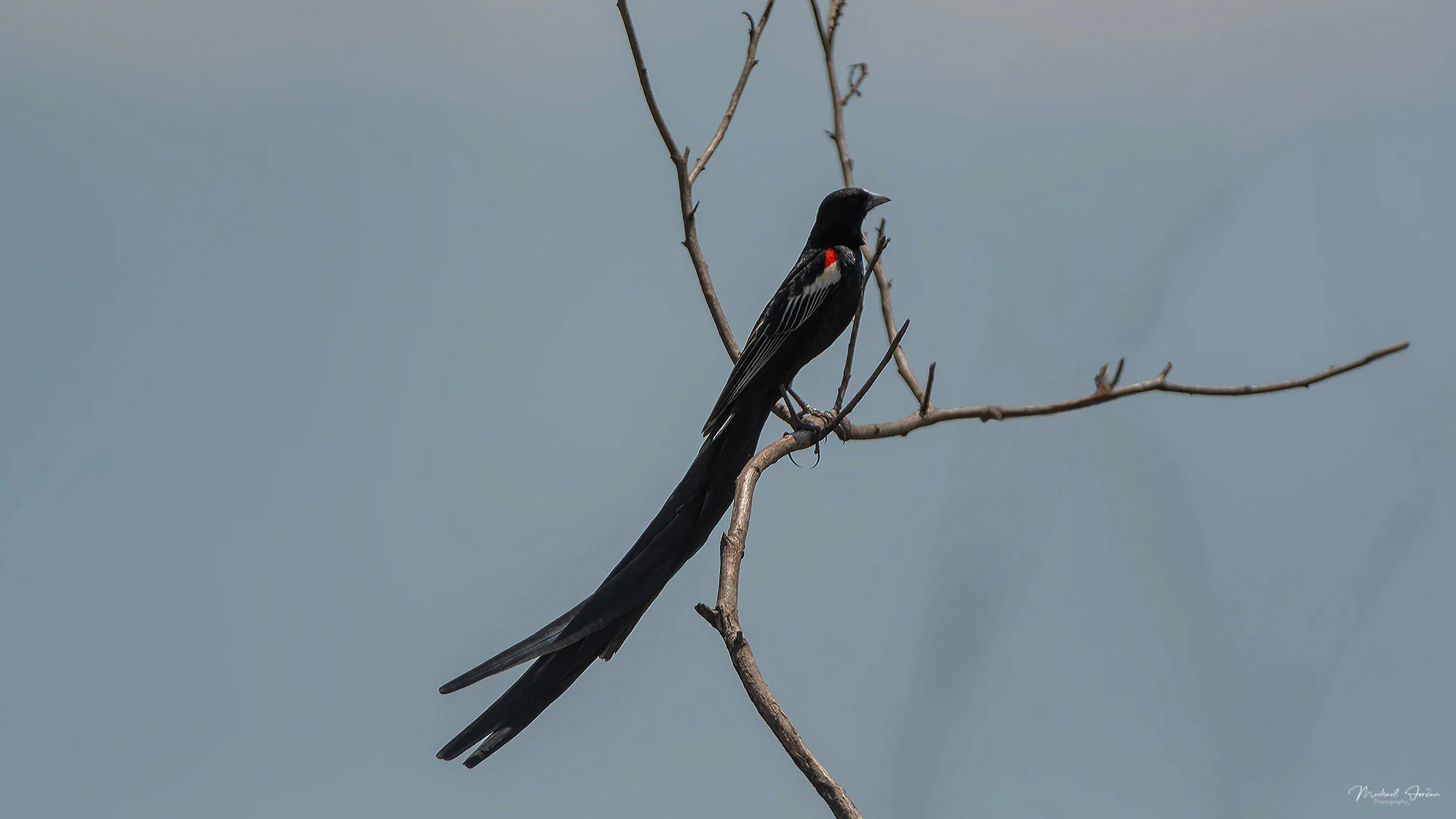
The breeding male is hard to mistake. He’s almost entirely black, with an orange-red shoulder patch edged in white, a pale bluish-white bill, and that tail. Six to eight of his twelve tail feathers grow to about half a metre long, so a bird with a body not much bigger than a sparrow’s can measure up to around 70 cm from beak to tail tip.
The females are a different story. They’re small, streaky buff-and-black birds with short, pointed tails and a horn-coloured bill, built to disappear into the grass. Youngsters look much like the females.
Here’s the catch: after breeding, the males moult the long tail and turn streaky and drab as well. In winter you’ll mostly see flocks of brown birds that you’d never connect with the summer showmen. The giveaway is often that the males keep the orange shoulder patch.
The tail that won an argument
The tail isn’t just for show. Actually, it is just for show, and that’s the point.
In 1982 a Swedish biologist called Malte Andersson ran a now-famous experiment on Long-tailed Widowbirds in the Kenyan highlands. He shortened the tails of some males, glued extra feather lengths onto others, and left some untouched. The males with the extra-long tails attracted the most females. The ones with clipped tails did worst, even though they kept displaying and holding their patches as usual.
It was one of the first clear field tests of something Darwin had suggested more than a century earlier: that females choosing mates can drive males to grow features that make life harder for them. Not bad for a bird most of us drive past on the way to work.
Where and when to find them in the Midlands
They’re birds of open grassland, especially damp or marshy grassland, from the valleys right up into the Drakensberg (they’ve been recorded at around 2,750 m). Around home that means [your local spots: vleis, grassy road verges, farm edges]. You’ll often see them from the car along the back roads.
Locally they’re also known as the Sakabula. In South Africa they breed through the warmer months, and early summer is when the males are in full plumage and displaying hardest. Outside the breeding season they gather in flocks and roost together in reedbeds or long grass.
One worrying note: comparing the two bird atlas projects (SABAP1 and SABAP2) shows the species has declined at many edges of its South African range, especially in KwaZulu-Natal. Healthy grassland and wetland matter for this one.
Behaviour
Each male holds a patch of grassland and spends his days patrolling it with that slow, deliberate display flight, wings beating heavily and tail hanging down in a deep keel, usually only half a metre to two metres above the grass. Females visit, look over the males and their territories, and pick. A successful male may have several females nesting on his patch.
The females weave dome-shaped nests low down in tall, dense grass, often in wetter spots, and do the incubating themselves. For the rest of the time, these birds eat mostly grass seeds, picked up on the ground, with the odd insect.
That tail has a cost. In wet or windy weather it gets heavy and awkward, and you can see the males struggling.
My two favourites
The one at the top taken along the Kamberg Road back in November of 2024 : This little guy was busy displaying when we first pulled up next to him before he decided to perch on this bit of grass before taking off again. If you wait long enough you can generally catch them hovering while they display for the females around.
Nikon D500, 200–400mm f/4 at 360mm, 1/6000s, f/4, ISO 250
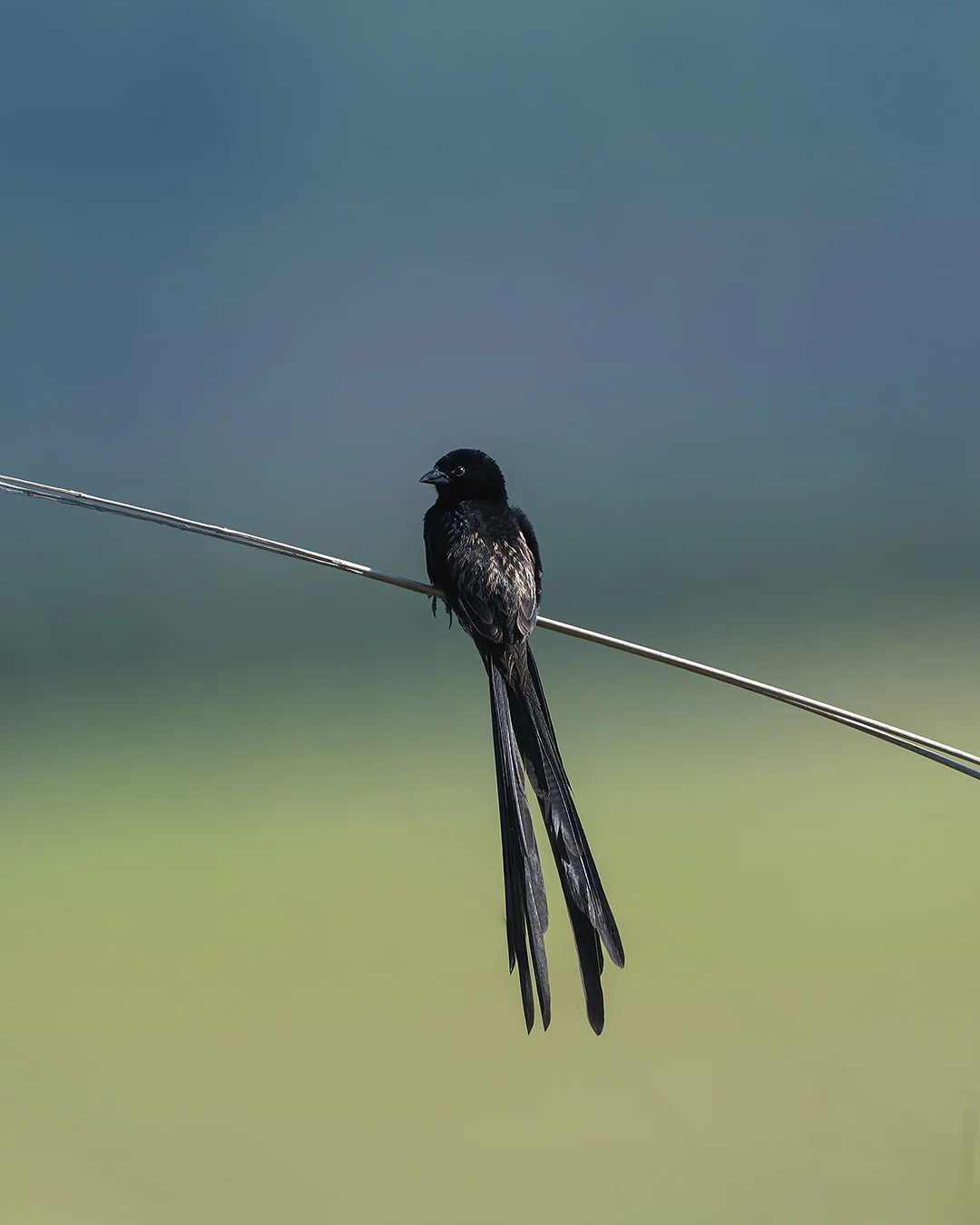
The below taken along the Kamberg Road in November of 2026 : Showing a nice side profile where you are able to see the red in the shoulder and the nice long tail.
Nikon D500, 200–400mm f/4 at [focal length], [shutter], f/[x], ISO [x]
Still on my list: a sharp, side-lit male mid-display with the whole tail in frame, and a female for comparison. One day.
Photographing them
A few things that work for me:
- Learn the circuit. A displaying male tends to fly the same loop over his patch again and again. Watch a couple of rounds, pick your spot, and let him come past you.
- Freeze it or pan it. For a sharp bird and tail, go fast: 1/2000s or quicker. For something with more movement, try panning at around 1/250–1/500s and let the wings blur. The slow, steady flight makes them one of the easier birds to pan with.
- Get low. They fly so close to the grass that shooting from car-window height or lower puts you level with the bird and turns the grass into a soft green background.
- Side light for the shoulders. All that black swallows light. Early or late sun from the side brings out the orange-and-white shoulder patch and the sheen on the feathers.
- Stay out of the long grass. The nests are hidden low in the grass right in the territory. Shoot from the road or the edge, and don’t walk into the patch. No bait, no playback: just patience.
- Watch the weather. A calm morning after rain can be magic, but on a really windy day the males fly less, and the tail goes everywhere.
Next time you see one
Next time you see a little black bird labouring over the grass with a tail that seems to have a mind of its own, pull over and watch for a while. You’re looking at one of the best examples of evolution in action anywhere, and it’s happening on the side of a Midlands road.
Stay tuned for the next part of Midlands regulars. If there’s a local bird you’d like me to cover, let me know.